
You've been handed the end-of-year function brief. Somewhere in Sydney with food, drinks, and an activity that doesn't end the night for half the room ten minutes in. The usual corporate function venues each fall short on one of those three. Pubs are just another night at a pub. Restaurants do the food but mean three hours in chairs. Bowling has an activity but only six people can play at once. Escape rooms work for an hour and leave the next two awkward.
The category most planners haven't considered is the licensed cue sports venue. The mechanics of why it works for a mixed work group are simple, but worth understanding before you compare options or pick up the phone.
What makes cue sports work for a corporate group
From a planner's perspective, the activity has to handle three things at once: mixed ability across the room, mixed energy across the night, and no requirement for someone with a clipboard to run things. Pool handles all three.
A first-time player can sink a ball within ten minutes of picking up a cue. An experienced player still has fun on a quality table because the cloth and the geometry feel different. That is unusual. Tennis, golf, and most racket sports demand a baseline of competence before they're enjoyable. Pool doesn't.
The conversation also doesn't stop. Shots take a few seconds. People talk between them. The activity sits alongside the room rather than dominating it the way a quiz night does or forcing collaboration the way an icebreaker does. The work conversations happen around the tables, not despite them.
And the night runs itself. Once cues are in hands, no one is reading from a sheet and no one is being asked to share an interesting fact about themselves.
For contrast, bowling has a queue dynamic where one person rolls and nine people watch, which across a 50-person group is a long night of watching. Escape rooms cap at six to eight per room and force collaboration that some attendees find draining. Both have their place. Neither scales for a corporate function the way pool does.
How a venue with 16 tables changes the maths
Most pool venues in Sydney have two or three tables. That's fine for a Friday night with friends. It's not fine for a corporate function with 50 people and a fixed three-hour window.
The maths is simple. If the venue has three tables and you've got 50 people, only 12 can play at once. The rest are waiting. Even with quick games, half the room is watching at any given time. Across a three-hour event, a good number of attendees will play one game and stand around for two hours.
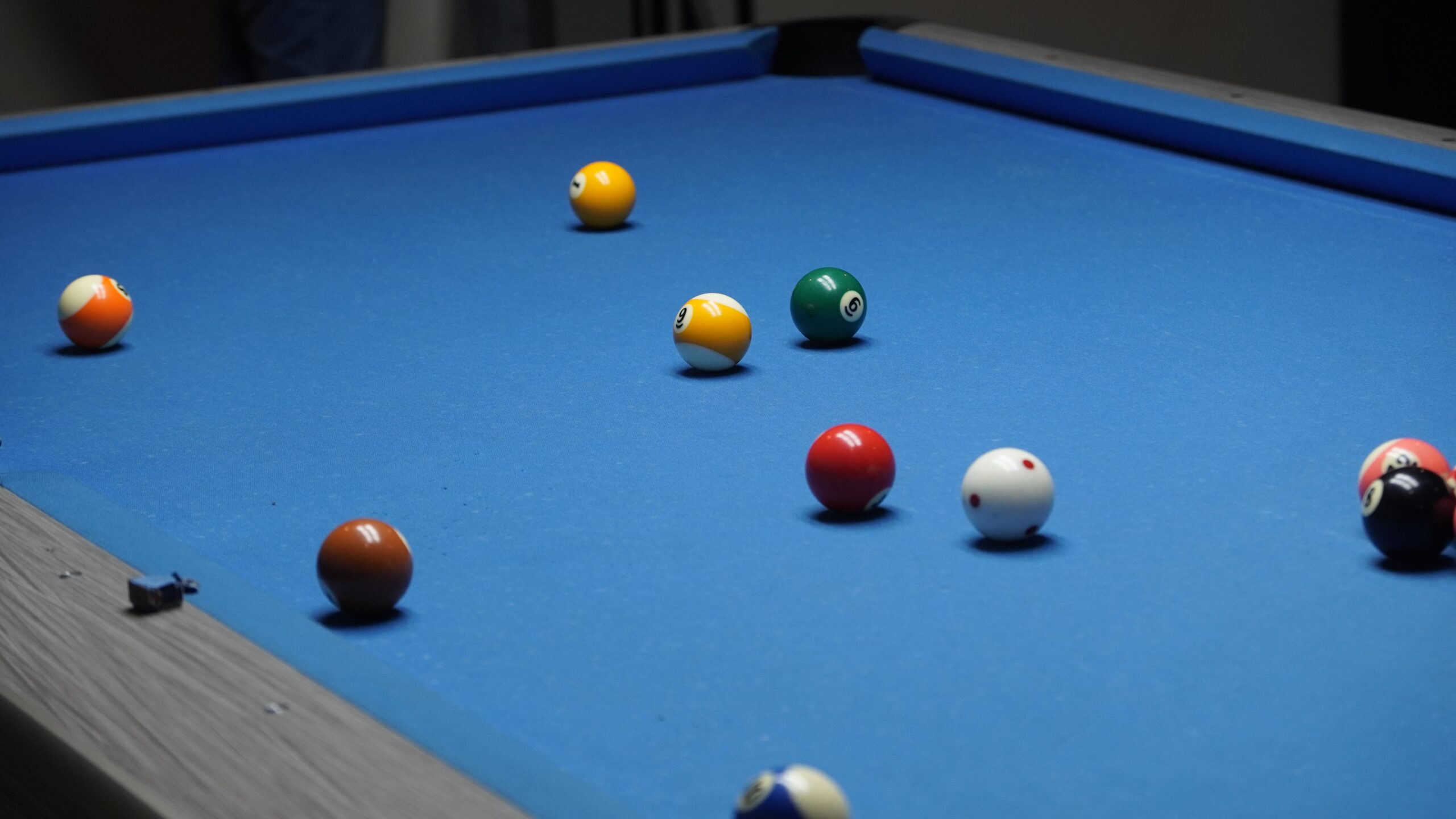
A venue with 16 tables flips this. Eight 9ft Diamond tables for American pool sit alongside eight 7ft Rasson Apollo tables for English pool. Add two championship shuffleboards and four steel-tip dart boards, and the activity capacity scales past most group sizes a corporate function will throw at it. Fifty people can be playing across the room at the same time.
This matters because corporate events run on a tight clock. Drinks at 6, dinner at 7, finished by 9.30 because half the room has trains to catch. If the activity has a queue, half the time-budget of the night is queue.
What to look for in a Sydney corporate function venue
The right venue depends on your group, but five questions are worth running every option past. How many people can actually do something at the same time. How long the activity holds attention before becoming a chore. Whether catering is a strength or a tacked-on extra. Whether mixed ability is welcome or quietly excluded. And what the cost lands at after exclusivity, deposits, and minimum spends.
The table below sketches how the main categories tend to compare. Specifics will vary by venue, but the patterns hold.
| Venue type | Group size handled | Activity duration | Catering | Mix of ability | Cost band |
|---|---|---|---|---|---|
| Pub function room | 20 to 100 | Passive (drinks, conversation) | Standard pub menu | N/A (no structured activity) | $$ |
| Restaurant private dining | 10 to 40 | Passive (plated meal) | Full menu, table service | N/A (no structured activity) | $$$ |
| Bowling alley | 8 to 24 active, rest watching | 60 to 90 min before flagging | Limited bar food | Easy entry, slow rotation | $$ |
| Escape room | 6 to 8 per room (capped) | 60 min, intense | Typically none | Forces collaboration | $$ |
| Cue sports venue | 30 to 120 simultaneously | 2 to 4 hours, self-paced | Full kitchen and bar | Easy entry, depth available | $$ to $$$ |
None of this is to write off pubs and restaurants for corporate functions. Both are the right call for some events. The point is that activity-led functions need an honest activity that scales, not one that becomes a queue.
What Club9 brings to a corporate function
The licensed cue sports venue category in NSW is small. Club9 in North Strathfield is the only fully licensed one, which is what makes it usable for a corporate function in the first place. Licensing covers food, alcohol, and a venue set up for groups, rather than a pool hall that tolerates them.
The numbers: 16 professional tables, eight of them 9ft Diamond for American pool and eight 7ft Rasson Apollo for English pool. Two 18ft Shufl championship shuffleboards. Four steel-tip dart boards. That is enough to keep a 50 to 80-person function running across multiple activity formats simultaneously. Larger functions can take exclusive use of the venue, which removes the public crowd and gives you the full floor.
The kitchen runs pizzas and bar food rather than a full plated dinner format, which suits a function where the food works alongside the activity rather than replacing it. The licensed bar covers cocktails, beer, wine, and spirits. DJs run on Friday and Saturday evenings as standard, and for private functions they can be added or omitted. The venue is open until 1.30am Friday and Saturday, so the night doesn't need to wind up at 10.
Logistics. The venue sits in the Bakehouse Quarter precinct in North Strathfield, three minutes' walk from North Strathfield Station on the T9 Northern Line. From Sydney Central it is a single train, around 15 minutes. The complex offers two-hour free parking with paid options for longer stays. For enquiries, the events manager (Stephanie) is on 0435 999 795.
What to ask before you book
Whatever venue you're considering, the answers to the questions below will tell you whether it is genuinely set up for corporate functions or just open to taking the booking.
- Capacity for your event style. Cocktail-style standing functions, seated dinners, and activity-led functions all use the same room differently. A venue that handles 80 for cocktails might only seat 40. Ask the number for your specific format, not the headline capacity.
- Exclusive vs shared use. Some venues run public trade alongside your function, which works for a low-key team night and doesn't work for a sales kickoff. Ask what's possible at the date and time you want, and what the cost difference is.
- Catering minimums and what they cover. Venues will often quote a per-head food figure that doesn't include drinks, or a minimum spend that doesn't include service. Get the number that covers everything you actually need.
- AV setup. If you've got a presentation, a speech, or a video, ask what is installed and what costs extra. Bringing your own gear works at some venues and not at others.
- Dietary requirements. Get the policy in writing before you finalise. A venue that handles dietaries cleanly will list them on the booking form. A venue that doesn't will say it can usually sort something out, and then can't.
- Cancellation policy. Functions get rescheduled. Ask what happens to the deposit if the date moves, if a percentage of attendees drops out, or if the event is cancelled outright.
- Deposit terms and timing. Standard is 25 to 50 per cent up front, with the balance on the day or shortly after. Confirm the dollar amount and the dates so the finance team isn't surprised.
Rates vary by table size (9-foot American tables cost more than 7-foot English tables at most venues), time of day, and membership status. Some venues charge more on weekends. Check the venue’s website or call ahead if you want an exact figure before you go.
Even at the top of the range, pool is one of the cheaper group activities in Sydney. Unlike bowling or escape rooms, there’s no per-person charge and no fixed game length – you play as long as you want, and everyone is at the table the whole time.
Frequently Asked Questions
The venue handles groups from around 30 to over 100 with multiple activity formats running at once. For exclusive use, larger groups are workable. For shared bookings inside regular trading, smaller groups of 30 to 60 are the more common size.
Yes. Exclusive use is available for larger or higher-stakes events, including sales kickoffs, EOFY parties, and product launches. The events manager can confirm dates and pricing for your group.
Yes. The kitchen handles common requirements including vegetarian, vegan, and gluten-free options. Note specific requirements on the booking form so they can be planned into the menu in advance.
For peak season (November to mid-December for Christmas functions, late June for EOFY) book at least eight to twelve weeks ahead. For off-peak months, two to four weeks is usually enough. Exclusive-use bookings need longer lead times in either case.
Yes. North Strathfield Station is a single train from Sydney Central on the T9 Northern Line, around 15 minutes. The venue is a three-minute walk from the station. Two-hour free parking is available in the Bakehouse Quarter for guests driving in.
Locking in a date
EOFY function bookings for late June and early July are already closing out at most Sydney venues. If you've got a date in mind, the events manager (Stephanie) at Club9 can walk you through capacity, exclusive-use options, and the catering setup for your group size on 0435 999 795. Online enquiries also go through the bookings link on the venue's website, and the events team will come back with availability and a quote.