


What is 9-ball pool?
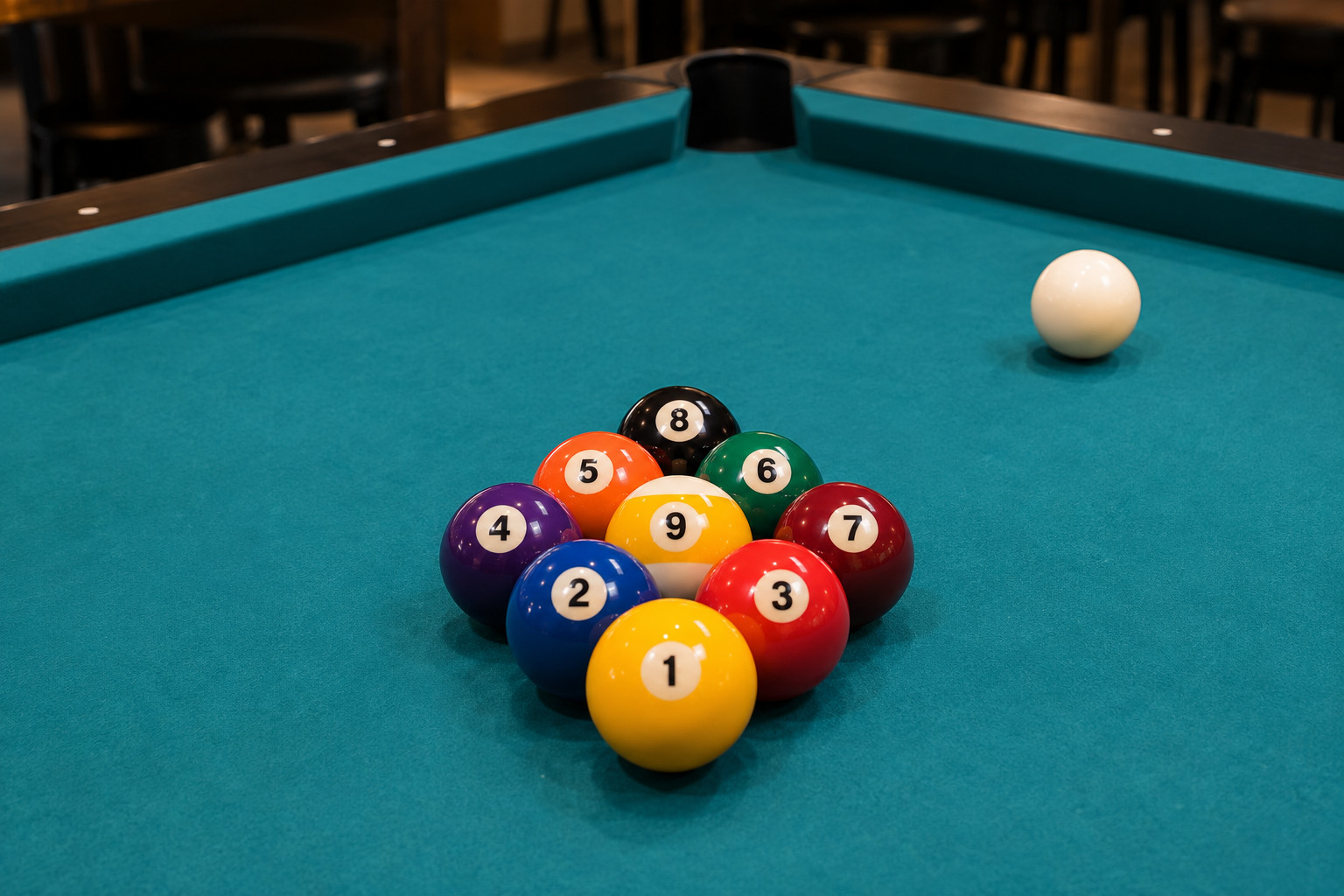
9-ball pool is a rotation game. Rotation means the balls are played in number order, from the 1 up to the 9. Nine object balls sit on the table, plus the white cue ball you strike. They are racked in a diamond shape at the start of each game. The 1-ball goes at the apex of that diamond, pointing up the table towards the player breaking. The 9-ball sits in the middle, on the foot spot, which is the marked spot at the racking end of the table. The rest go in no particular order.
The contrast with 8-ball is worth holding onto. In 8-ball there are fifteen object balls, and you own a group of seven of them. You clear your group before you are allowed to shoot at the 8. In 9-ball nobody owns anything. Both players shoot at the same ball, and that ball is whichever one has the lowest number left on the table.
How do you win at 9-ball?

You win the rack by legally potting the 9-ball. Nothing else ends the game. You do not have to pot the other eight yourself, and you do not have to pot them last.
That opens up two finishes that catch new players out. The first is the combination. The ball you hit first and the ball you pot do not have to be the same ball, so you can strike the lowest-numbered ball and send it into the 9. If the 9 drops, the rack is yours, even with six balls still sitting on the table.
The second is the break. A player who legally pots the 9-ball on any shot wins the rack, and the break is a shot like any other. So a 9 on the break ends the game there and then. It does not happen often, and it is part of why the game is good to watch.
What are the rules of 9-ball?

Four rules carry the whole game. Learn these and you can play a rack tonight.
The break has a rule of its own. The cue ball starts in hand behind the head string, which is the line drawn across the top quarter of the table. If no ball is potted, at least four object balls must be driven to a rail, or the break is a foul.
- Lowest ball first. The first ball your cue ball touches on every shot must be the lowest-numbered ball left on the table. Hitting anything else first is a foul. The rule book calls it wrong ball first.
- Ball in hand on a foul. When you foul, your opponent picks the cue ball up and places it anywhere on the table before their shot. That is a heavier penalty than most pub rules carry, and it is the main reason a strong player pulls away from a weak one.
- The push out. On the second shot of the rack only, and only if the break was not a foul, the player may declare a push out. They can then play the cue ball anywhere they like, without hitting the lowest ball first and without driving a ball to a rail. If the push out is not a foul, the other player chooses which of them shoots next. It exists so a player who breaks into an unplayable position is not simply stuck.
- Three fouls in a rack. Foul three times in one rack without a legal shot in between and you lose that rack. The rule book asks a referee to warn a player who comes to the table on two fouls. If no warning is given, a third foul counts only as the second.
One more thing to know about the 9. If it is potted on a foul or on a push out, it goes back on the table. No other ball is ever put back.
Is 9-ball or 8-ball better for a beginner?

8-ball, and it is not close. Two things make 9-ball hard on a player who is still learning.
The first is ball in hand. One foul hands your opponent the cue ball anywhere they want it. A player who can string three or four balls together will often clear from there, so a single mistake costs you the rack rather than a turn. In 8-ball the same mistake costs far less.
The second is the safety shot. When you cannot pot the lowest ball, the right play is to leave your opponent with nothing to shoot at. That is a safety, and it takes real control of the cue ball. Beginners do not have one yet, so they either take a low-percentage shot or give away ball in hand.
None of that makes 9-ball a bad game to try. The order rule means you never have to work out which balls are yours, which is one less thing to hold in your head while you are learning. Play a few racks of 8-ball first, then come back to it.
Which table do you play 9-ball on?

9-ball is an American pool game, so it is played on an American pool table rather than the smaller English table you find in most pubs. The big American tables suit it, because the game asks you to move the cue ball a long way and land it accurately. The rules themselves do not name a table size. There is more on what a Diamond table does to your game in a separate post.
Where can you play 9-ball in Sydney?

You need a room with American pool tables, and those are not common in Sydney pubs. Most pub tables are the English size, which suits 8-ball. So a rotation game means going somewhere that was built for it.
Club9 is one of those rooms. It sits in the Bakehouse Quarter at North Strathfield, about a three-minute walk from North Strathfield Station, and it has nine-foot American tables. It is a licensed, adults-only members’ club, and walk-ins are welcome. Everyone signs in at the front desk on arrival. Tables are hired by the hour and the gear comes with them, so you do not need to own a cue to play.
If you want a rack of 9-ball rather than a frame of 8-ball on a pub-sized table, ask at the front desk for one of the American tables. There is more about them on the American pool page, including the other games they get used for. The venue also runs 9-ball competition through the year, and its tournaments page lists what is coming up. If you would rather ask before you come in, send the venue a message first.
Frequently asked questions
Can you win 9-ball on the break?
Yes. The break counts as a shot like any other, so a legal pot of the 9 straight off the break takes the rack immediately. No other ball has to go down for that to stand.
How many balls are used in 9-ball?
Ten in total. Nine are object balls, numbered 1 to 9, and the tenth is the white you play with. That is six fewer object balls than an 8-ball rack, which is a large part of why the game moves so fast.
Is 9-ball harder than 8-ball?
For a new player, yes. The rule about what to hit is simpler, but the cost of getting it wrong is much higher. There is also no group of your own balls to pick from when the lowest one is sitting somewhere awkward.
Do you need your own cue to play 9-ball?
No. Hiring a table includes the equipment, so you can arrive with nothing and still play a rack. The rules govern the balls and the shots, not what you hold.